Brazil is the Portugal play. Portugal isn’t.
The conventional answer is Portugal. The better-argued case is Brazil bigger market, younger population, faster citizenship, and a downstream path into Portugal itself that no one going directly to Lisbon can access.
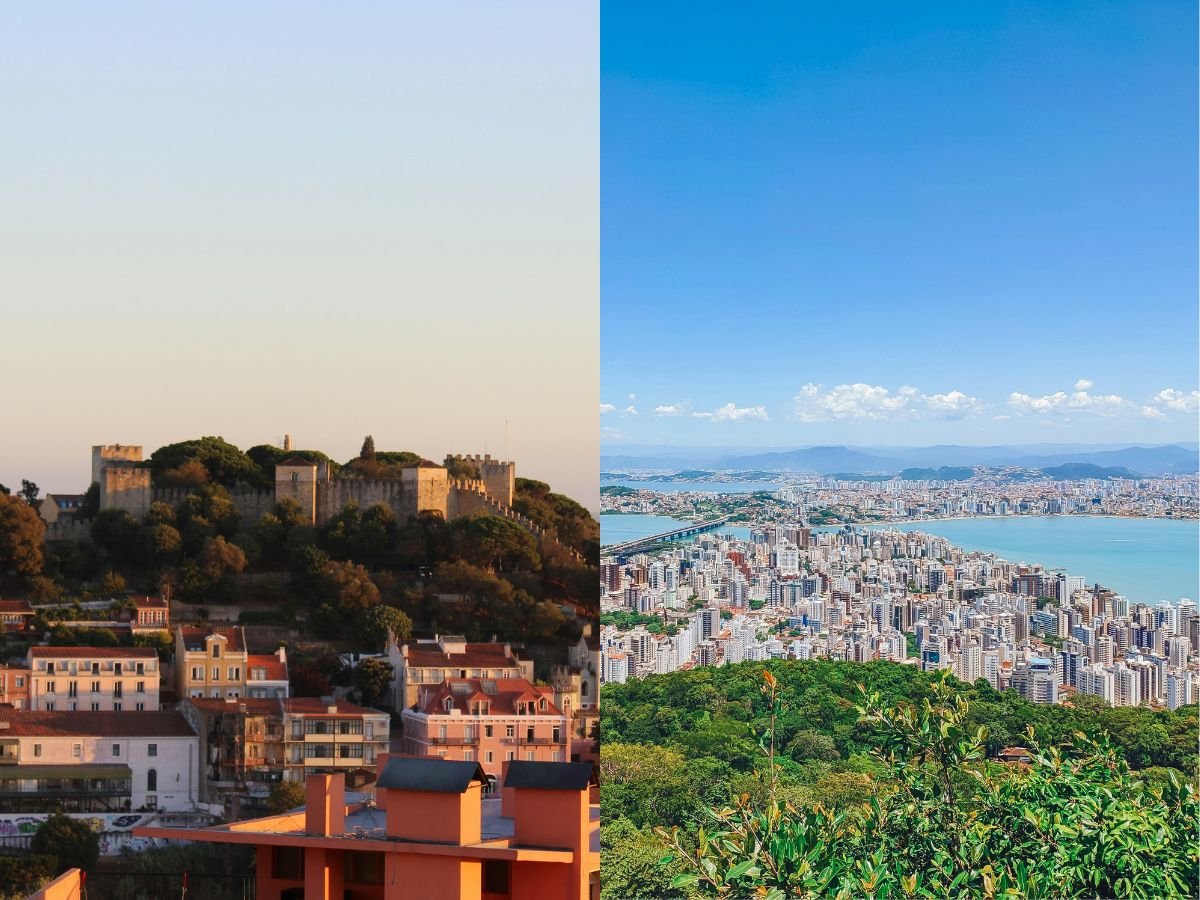
Essay · The case most people aren’t making and the data behind it.
The conventional answer to “where should I build my second base in the Portuguese-speaking world” is Portugal. It has European Union membership, a recognizable name, a well-worn expat track, and until very recently a reasonably clean five-year path to an EU passport. The conventional answer has been the wrong one for a while. It has become more obviously wrong in 2026.
The better-argued case is Brazil. Not instead of Portugal as a destination instead of Portugal as a strategy. The thesis is this: Brazil gives you everything Portugal offers an entrepreneur, at larger scale, at lower cost, on a faster citizenship timeline, with a downstream option into Portugal itself on terms no one going directly to Lisbon can access. The argument is not close.
The numbers that don’t get said out loud
Portugal has ten million people. Its median age is approximately 46 among the oldest in Europe. Its economy, by GDP, sits outside the top twenty globally. Lisbon, the city that concentrates most of what makes Portugal interesting to outsiders, has become expensive by any honest comparison: a one-bedroom apartment in a desirable neighborhood now runs €1,400 to €1,800 per month, comparable to Prague or Barcelona, without the salary base that makes those cities tolerable.
Brazil has 215 million people. Its median age is approximately 33. Brazil’s economy is the largest in South America, offering business and job opportunities in diverse sectors. A one-bedroom apartment in Florianópolis a tech-adjacent coastal city with direct flights to São Paulo and Buenos Aires runs the equivalent of $600 to $900 per month. Curitiba, consistently ranked among the best-planned cities in Latin America, is cheaper still. São Paulo is more expensive than both, and still a fraction of Lisbon. Baby In Brazil
The demographic argument is not subtle. A young population is a growth story. An aging population is a maintenance story. For an entrepreneur evaluating where to build something, the difference between a median age of 33 and a median age of 46 is not a lifestyle preference it is a structural market reality. Brazil has a labor pool, a consumer market, and an energy that Portugal cannot offer at comparable scale.
What the citizenship math actually says
This is where the comparison becomes most concrete, and where the conventional narrative has become most misleading.
The standard residency requirement for Brazilian citizenship is four years, but it can be reduced to one year for those who have a Brazilian spouse or child born in Brazil. Four years of legal residency, Portuguese language proficiency, clean record, and a conversational interview with the Federal Police. Processing typically runs twelve to fifteen months after eligibility. A founder who arrives in Brazil this year and follows the standard path holds a Brazilian passport before the end of the decade. Immi legal
Portugal’s situation is materially different. Parliament approved a reform in October 2025 and again in April 2026 with a two-thirds supermajority both times extending the citizenship residency requirement from five years to ten for most non-EU, non-CPLP nationals. The law awaits presidential signature as of this writing. Anyone planning around Portuguese citizenship today who is counting on five years is planning on a number that no longer reflects the regulatory direction. Plan for ten.
There is a further complication Portugal’s promotional materials do not emphasize. Even under the old five-year rule, the residence clock starts only after a residence permit is formally issued, not from the date the application is submitted. Since residence permits in Portugal often take two to three years to process, many applicants could face total waiting periods of nine to thirteen years before qualifying for citizenship. ROC Citizenship
The comparison then is: Brazil, four years from arrival, realistically five to six including processing. Portugal, ten years from permit issuance, realistically twelve to thirteen for many applicants given processing backlogs. This is not a marginal difference. It is a decade.
The play nobody is making explicit
Here is the argument that almost no publication covering this space is making clearly, and that Building Elsewhere intends to stand on.
Brazilian citizens are CPLP nationals members of the Community of Portuguese Language Countries. Under the 1953 Treaty of Friendship, Cooperation and Consultation between Brazil and Portugal, Brazilian citizens in Portugal receive near-citizen rights without full naturalization and qualify for a seven-year citizenship track, not the ten-year standard track now facing most other nationalities.
The sequence this creates is specific and valuable. Relocate to Brazil. Build your life there, your business there, your language there. Acquire Brazilian citizenship at four years or sooner if you have a Brazilian child or partner. You now hold a Brazilian passport with visa-free access to more than 170 destinations. You also hold CPLP status. When and if you decide Portugal is part of the longer arc, you enter the Portuguese naturalization process on the seven-year preferential lane, not the ten-year standard one.
Brazil gets you into Portugal on better terms than going directly to Portugal as an American, a Canadian, or a British national.
This is not a theoretical benefit. It is a structured legal advantage built into a bilateral treaty that has been in force for more than seventy years. It is also not well-understood, because most coverage of the two countries treats them as separate decisions rather than as a sequenced strategy.
The language investment argument
Learning Portuguese in Brazil means learning it from 215 million native speakers, in the largest Portuguese-speaking country on earth, in a version of the language that is deeply influential across South America and Lusophone Africa. Brazilians resident for at least three years are eligible to vote in Portuguese elections and serve in public office there. The language itself opens Angola, Mozambique, Cape Verde, and the other Lusophone African markets places Building Elsewhere tracks as part of the next emerging market story in ways that European Portuguese simply does not. Wikipedia
Learning European Portuguese means learning from ten million people, in a country with a shrinking labor force and an economy that, by the honest measures, is not where the next decade of growth is happening.
The language investment is identical. The return is not.
What Brazil is not for
Having made the case, a few honest disqualifications. Building Elsewhere publishes these in every country piece, and Brazil deserves a clear-eyed version.
The tax structure for residents requires serious advance planning. Brazil operates a progressive personal income tax system with a top rate of 27.5 percent. Once you establish tax residency, you are taxed on worldwide income. From January 2026, a 10% withholding tax applies to dividends paid to nonresident shareholders. For high earners, Law 15,270/2025 introduced a minimum individual income tax IRPFM that applies to annual income above BRL 600,000, with rates scaling to 10% above BRL 1.2 million. Brazil is not a low-tax jurisdiction for residents. It is a large, dynamic, affordable-to-live-in country with a complex tax system. These are different things, and confusing them is expensive. Experts for ExpatTaxes for Expats
The “custo Brasil” is real. Brazilian founders and businesspeople use this phrase constantly, and they mean it. Corporate tax at the entity level runs approximately 34% on business profits. Labor regulations under the CLT are among the most employee-protective in the world, which matters if you are hiring locally. Company registration, while improving, remains more bureaucratic than Uruguay or Georgia by a significant margin. None of this is a dealbreaker for the right operator. It is a serious operational consideration that deserves honest acknowledgment.
Safety in major urban centers São Paulo, Rio de Janeiro requires contextual awareness that life in Lisbon or Montevideo does not. Florianópolis and Curitiba have materially different profiles than the two largest cities. Where you choose to base yourself within Brazil matters considerably, in ways that choosing between Lisbon neighborhoods does not.
And Brazil is not for someone whose only Portuguese is theoretical. The naturalization interview is conversational. The daily bureaucracy is in Portuguese. The business environment is in Portuguese. This is not an obstacle; it is a reasonable integration requirement for a country of 215 million people. But it requires genuine language investment, not just a Duolingo streak.
The investor pathway
For entrepreneurs eyeing Brazil’s expanding economy, the investment-based residence offers a strategic pathway. Specifically, this requires a minimum capital injection of R$500,000 into a Brazilian business or the creation of ten local jobs. At current exchange rates, R$500,000 represents approximately $90,000 to $100,000 USD a threshold that compares favorably with most comparable investor pathways in Europe or the Caribbean. Martin Law Firm
The fully codified digital nomad visa (VITEM XIV) requires remote workers to prove just $1,500 a month in income or $18,000 in savings one of the lowest financial thresholds in the G-20. For a founder not yet ready to commit to the investment pathway, the digital nomad visa is the correct entry point: low threshold, legal status, time to evaluate the country properly before committing capital. VisaHQ
The cities are the argument
One thing Portugal genuinely cannot offer: internal diversity of operating environment. Portugal is essentially one city and several smaller ones. Brazil has Florianópolis a 500,000-person tech hub on an island off the south coast, with some of the best surf in South America and a cost of living that would embarrass Lisbon. Curitiba — well-planned, cool climate, strong German and Italian cultural influence, a city that consistently outperforms its size in quality of life metrics. Recife — the most underrated startup ecosystem in the country, warm, coastal, a fraction of São Paulo’s cost. Belo Horizonte. Porto Alegre. Each of these cities is not a compromise for someone who can’t afford São Paulo. Each is a deliberate choice.
The thesis is not that Brazil is easy. It isn’t. The thesis is that Brazil is the more serious argument for the entrepreneurially serious reader bigger market, younger population, faster citizenship, lower cost of living in the cities that reward the lifestyle, and a downstream path into the EU that no one going to Lisbon directly can access.
Portugal is a fine country. It is not the play. Brazil is.
The Brazil dossier covering the specific visa pathways, tax mechanics, Decree 12,657/2025, and city-by-city cost of living is available for deep coverage of the mechanics. This essay is about the argument that precedes the logistics. For readers still in the clarity stage, the clarity essay covers the decision that comes before any of this.